
How a Pile of Books Led to a Family Standoff.

Today, I have been thinking a lot about change.
Perhaps it is because I have been reflecting on how much of life is shaped by transition.
Children grow up, families evolve, careers take unexpected turns, and the people we love leave behind memories that continue to shape us long after they are gone. Beyond our personal lives, we are also living through a period of significant global uncertainty. Economic volatility, conflicts around the world, changing national priorities, and evolving social norms have left many people questioning what the future might look like.
Many of the foundations people once relied upon for stability seem to be shifting in ways that are often difficult to predict.
Whenever I find myself reflecting on change, a particular memory of my grandmother comes back to me. It is one of the funniest stories from our family, but it also contains a lesson that has stayed with me for years.
As I have shared before, when I started my own family, my grandmother lived with us. She made life incredibly easy for me. I would leave for work knowing that everything else was under control. She cared for the children, taught them, and loved them deeply. Looking back, I sometimes joke that I do not know exactly how my children learned to walk or became potty trained because she handled so much of it.
One thing about my grandmother was that she never stopped being a teacher.
Even after retirement, she continued waking up early to prepare notes, write stories, read books, and organise learning materials. Teaching was not simply a profession for her. It was part of her identity.
Naturally, she started teaching my children very early. Even as babies, she would patiently introduce them to everyday objects, words, and ideas. By the age of one, they could recognise words, identify letters, scribble, and begin reading simple words. More importantly, they developed a love for books.
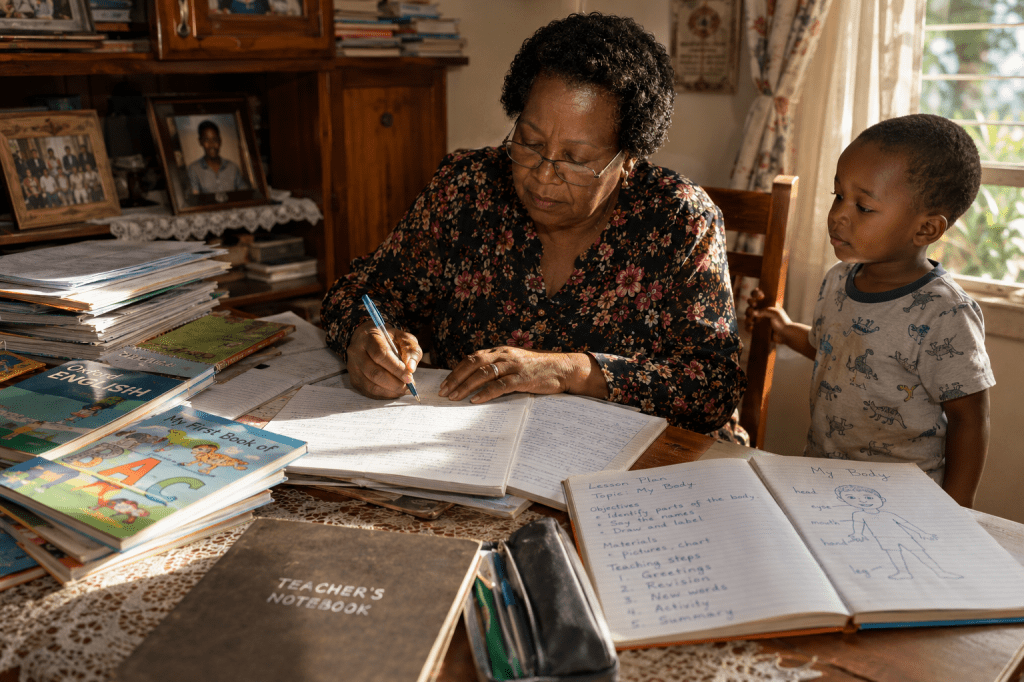
That love came directly from her.
Books were my grandmother’s greatest treasure.
If you asked her what she wanted as a gift, the answer was almost always books, notebooks, magazines, or something else to read. You could buy her beautiful fabric or jewellery and she would carefully store them away. But books were different. They occupied the most important spaces in her room. She handled them carefully. She treasured them.
The way she treated books told you everything about how much she valued knowledge.
….
One day, she decided that my son, who was almost two years old at the time, was ready for a new level of learning. My grandmother always believed in teaching children ahead of where they were. If a child was in one class, she was already preparing them for the next.
She asked us to buy a number of books for him.
We returned home with a large bag full of books.
Everyone was excited.
Together, she sat with him in her room looking through the books. They talked about them, flipped through the pages, and examined them carefully.
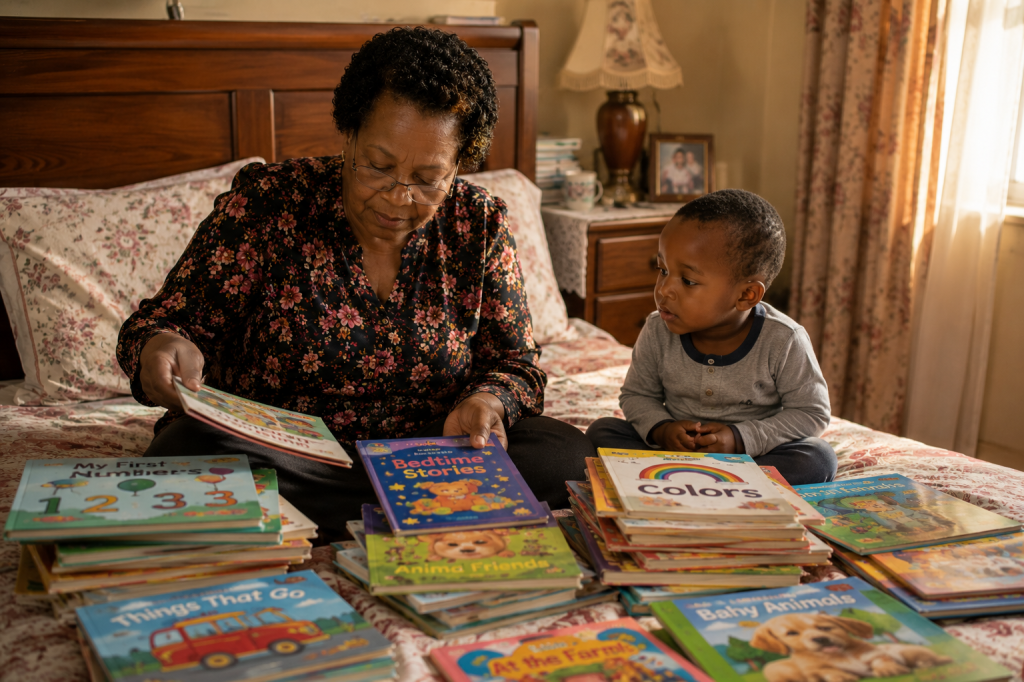
After some time, my grandmother decided she would separate the books. Some would be used immediately and the others would be saved for later.
What she did not realise was that my son was paying very close attention.
He was almost two years old, but he clearly did not approve of this arrangement.
Of course, he could not articulate that.
He simply sat there quietly watching.
A little later, my grandmother stepped out of the room to get some water.
A short while afterwards, we heard her calling.
My son had locked himself inside the room.
We started calling his name.
Nothing.
He ignored us completely.
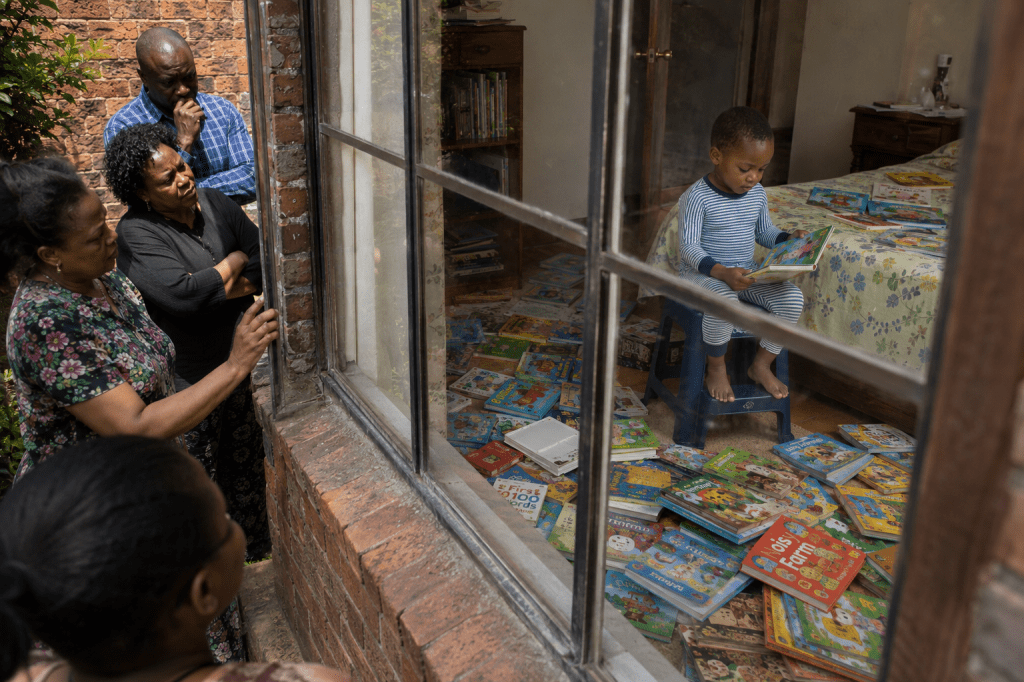
We rushed around to the back of the house and peered through the windows.
And there he was.
Sitting comfortably beside my grandmother’s little table and stool.
The books were spread all around him.
He had arranged them in piles and was flipping through them one by one, completely absorbed.
We begged him to open the door.
He refused.
We asked him why he locked the door..
His answer was very clear.
Grandma wanted to take some of the books away.
The books belonged to him.
He intended to use all of them.
Nobody was taking them anywhere.
….
For over an hour we pleaded, negotiated, reasoned, and tried everything we could think of. Nothing worked.
He simply continued examining his books.
At one point the electricity went off. We assumed the darkness would frighten him enough to come out.
It did not!
When the generator came on minutes later and the lights returned, he was still in the exact position we saw him in before the lights went out.
Still surrounded by books.
Still refusing to open the door.
By this point, my grandmother was laughing and crying at the same time. She did not know whether to be worried or amused.
I, on the other hand, was thoroughly frustrated.
Eventually, we had to break the door handle to get inside.
The moment the door opened, I was ready to react.
My grandmother stopped me.
“Leave him,” she said.
And what happened next made all of us burst out laughing.
My son calmly gathered several books into his arms, hugged them tightly against his chest, walked straight past all of us, went to the dining table, sat down, and continued reading.
No apology.
No explanation.
No concern whatsoever about the chaos he had caused.
Just books.
The door had been opened, the adults had been defeated, and the books were finally safe.
….
Afterwards, my grandmother could not stop talking about the incident.
The more she reflected on it, the more fascinated she became.
What intrigued her most was that nobody had deliberately taught my son to protect those books. He had simply absorbed what he had observed. For my grandmother, that was the remarkable part.
Her insight was simple but profound: influence often takes root long before anyone realises a lesson is being learned.
My son had spent months watching her treat books as treasures. He had watched her protect them, organise them, value them, and delight in them.
Nobody had taught him to lock himself in a room with books.
Nobody had instructed him to protect them from being taken away, because that was never the intention.
Yet he had absorbed her behaviour so completely that, even at that age, he acted on it.
That experience became an eye-opener for my grandmother. She later wrote and spoke extensively about behavioural influence and observation.
She believed people often underestimate how much behaviour is shaped by observation. It does not matter whether the observer is a toddler or an adult. We are constantly learning from one another through what we repeatedly see, hear, and experience.
Nor does influence always happen through formal teaching. Sometimes it is found in small actions repeated over time. A habit, a routine, a reaction, or a value consistently lived out.
My son’s response to those books was not the result of a single conversation. It was the result of months of watching my grandmother treat books as treasures.
That was a lesson that stayed with me throughout the years.
….
At a time when I find myself confronted with the complexities of life, grief, uncertainty, and change, I am reminded that the things we do every day matter. The words we use, the habits we practise, the values we embody, and the way we treat others all leave an impression, often in ways we may never fully understand.
My grandmother understood something that I am only now fully appreciating: we teach every day, whether we realise it or not. Long before people listen to what we say, they observe how we live.
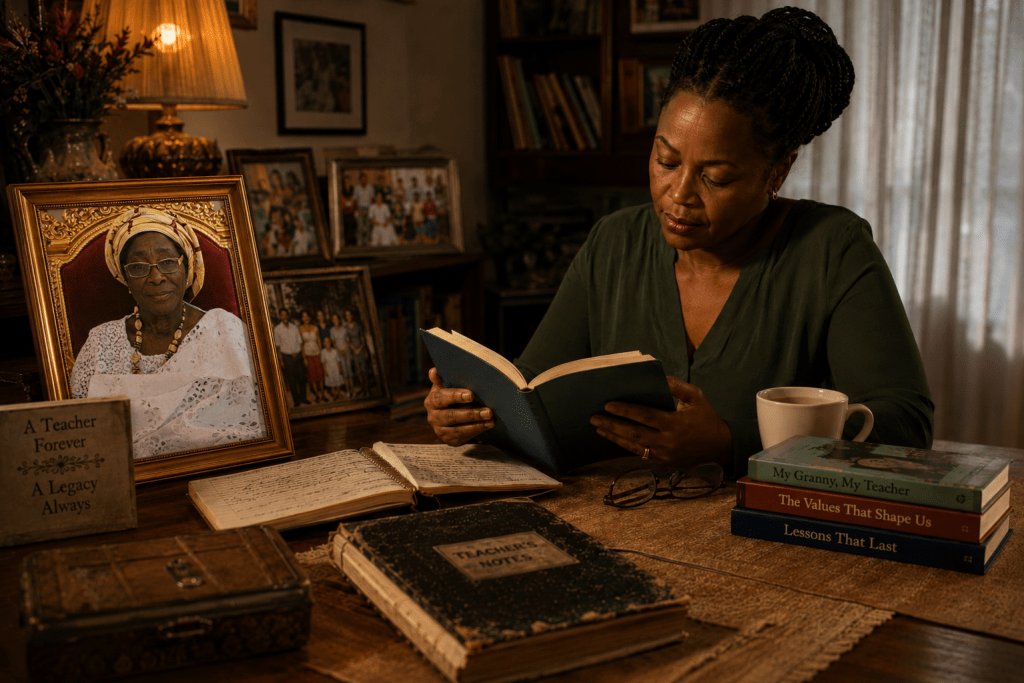
That lesson feels especially important now. In a world that often rewards quick reactions and loud opinions, my grandmother taught me the value of reflection, lifelong learning, and being mindful of the influence we have on others.
The generation before us shaped us, often without realising it. In the same way, our words, actions, and values quietly shape those around us and those who come after us.
The older I get, the more I realise that while circumstances change, the values we carry with us often determine how we respond to that change.
As I navigate this season of my life, I find myself thinking less about the little boy who locked himself in a room with a pile of books and more about the woman who unknowingly inspired him to do so.
Change is inevitable, but the values that anchor us through change are a choice.
For me, those values are curiosity, humility, thoughtfulness, and a commitment to keep learning.
It is not really a story about a little boy and a pile of books.
It is a story about influence, about the quiet ways we shape one another, and about the values that endure long after circumstances have changed.
….
My grandmother is gone, the children she taught are grown, and the world around us is very different from the one she knew. Yet her example remains.
And perhaps that is the lesson I keep returning to: in a world of constant change, the examples we set may be our most enduring legacy.
I will leave you with a question worth reflecting on: what lessons are our words, actions, and values teaching, often without us even realising it?


Leave a comment