In my generation, childhood wasn’t just a period of growth; it was a time of deliberate shaping. The goal of nurturing was to shape children into self-sufficient, morally upright, and useful citizens. Success, in this sense, was measured not only by career milestones or household income, but by the ability to raise responsible citizens, cultivate strong and compassionate family leaders, and nurture individuals who extend care and kindness beyond their immediate family to the wider community.
Creativity and self-reliance were the norms. From an early age, each child was encouraged to cultivate hands-on skills, strengthen practical abilities, and take responsibility in contributing to the care and work of the household. Families lived off what they grew on their farms, and even in the cities, backyard gardens were a standard feature. This lifestyle made life less expensive and more inclusive; large households could thrive, and extended family members could be cared for, because everyone played a role in sustaining the home.
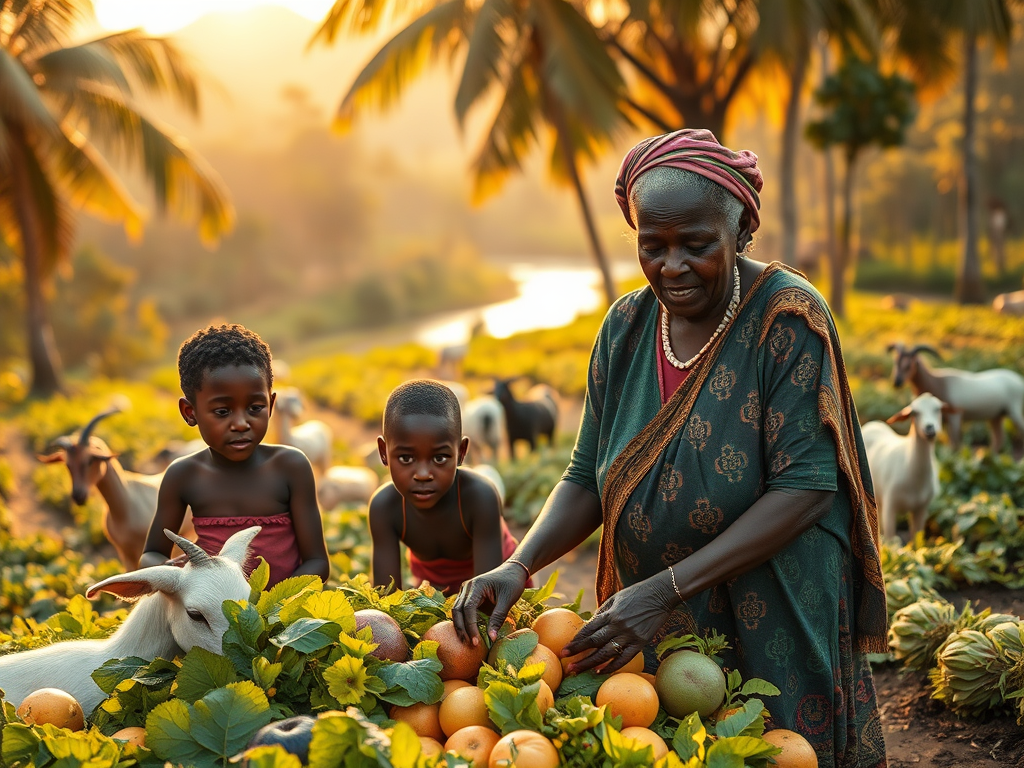
For my grandmother, nearly 80% of her household’s food and essentials came directly from her farms. With no fewer than fifteen household members at any given time, this was a remarkable feat. Each day involved a carefully orchestrated rhythm of planting, tending, harvesting, cooking, and maintaining the home. Children and adults alike had clearly defined roles, from feeding livestock to preserving food, ensuring that everyone contributed to the household’s well-being. It was a system that combined ingenuity, discipline, and cooperation—one that not only met material needs but also reinforced a deep sense of responsibility, community, and shared purpose.
The Farm as a Living Classroom
Her farms were a living classroom, where nothing grew without purpose. Each crop carried layers of value, offering food, tools, and lessons in ingenuity. The palm fruit trees, for example, produced oil that sizzled in cooking pots, while their leaves were stripped and woven into brooms and sturdy baskets that stored harvests or used to fish from the river. Everywhere, the land taught us creativity and self-reliance.
Each day began with a walk to the farms—30 to 45 minutes along narrow paths, tools resting on our shoulders. Fifteen to twenty of us moved together in a line, our laughter and songs drifting lightly across the fields. The rhythm of our steps, the chatter, and the occasional clink of metal against wood made the journey feel less like a chore and more like a ritual. The excitement of discovering snails, mushrooms, and other small gifts from nature along the forested paths added a sense of wonder, turning the walk into an adventure and a chance to connect with the land around us.
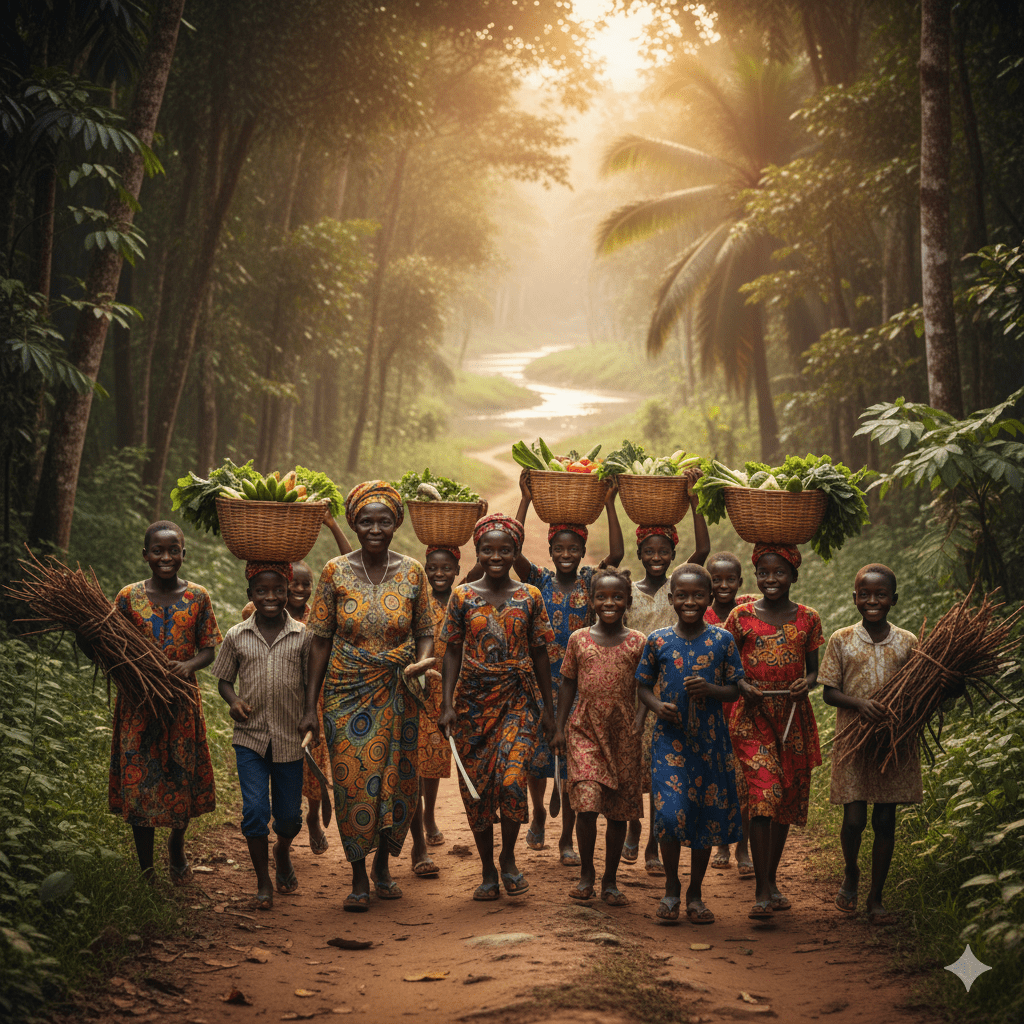
To ensure a steady supply, my grandmother grew a wide variety of fruits and vegetables and raised livestock. Goats and sheep were led to graze in the afternoons, while fowls roamed freely but always laid their eggs in familiar spots. With farms spread across four locations, household members were split into teams to bring food home daily. My favourite was the one near River Ayensu. We had to cross the bridge and walk right along the river bank to get to the farm . There was always something to see. Another was called “Agyei”. We used to cook delicious meals right in the farm.
Weekend Rhythms
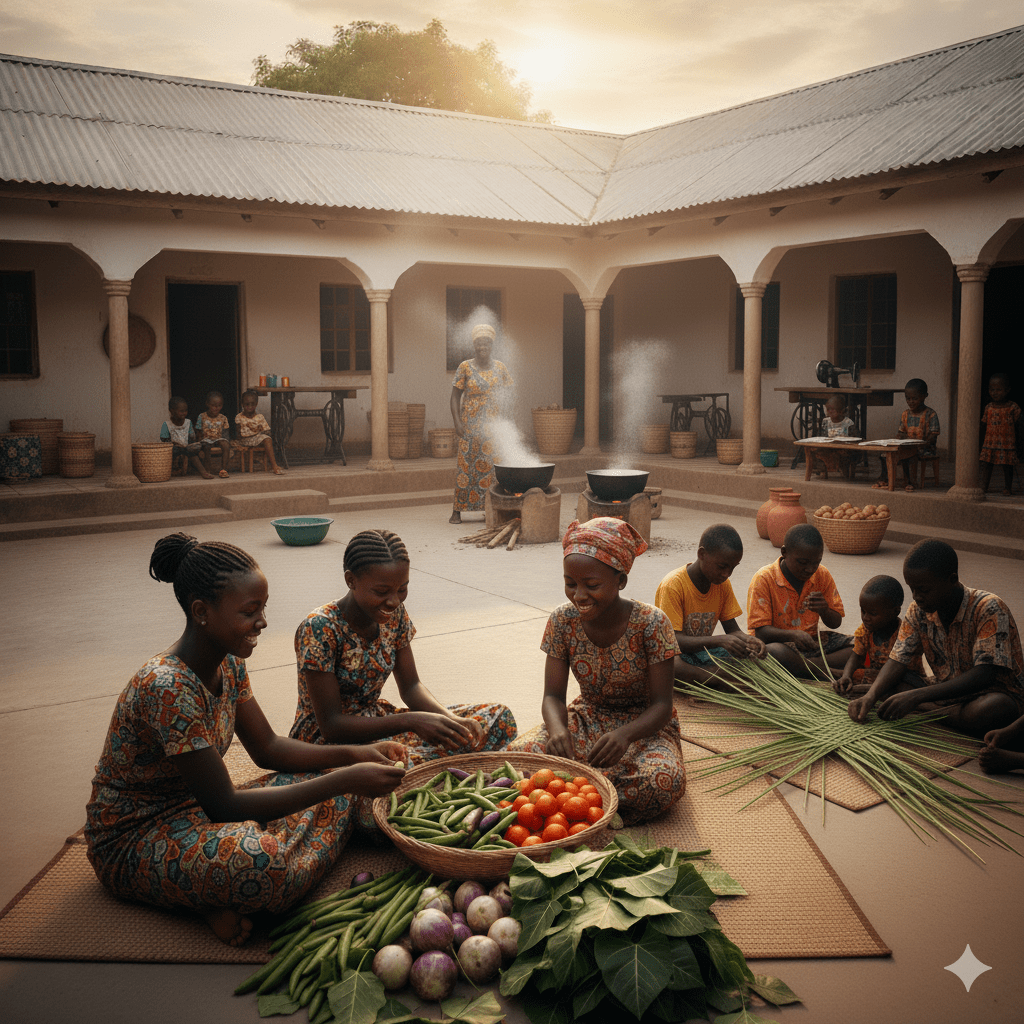
Weekends had their own rhythm. Saturdays began at 6 a.m., with everyone on the farms, and by 11 we returned home to process the harvest. Groups gathered in circles—some weaving brooms, others shaping baskets, or shelling dried corn. Even firewood and clay for pots came from the land, reinforcing the lesson that nature provided everything we needed if we worked for it.
Sundays, by contrast, were a day of rest. There was no farming; the entire household went to church, then returned home for a quiet siesta and preparations for the week ahead.
Lessons in Resilience and Generosity
The most immersive learning came during the two years I lived with her continuously. Even after my teenage years, during university breaks, I returned to her home. The rhythm never changed even in my adult years: morning service at the Presbyterian Church, study sessions, and long walks to the farm. She gathered herbs for teas and remedies, distributed surplus food to the less privileged, and taught us that generosity was as vital as survival. I remember days when I was tasked with delivering meals to a blind woman nearby and to an elderly man afflicted by a stroke. Other members of the household had their own assigned tasks, and we carried them out with joy, knowing that eager hands awaited the gifts we brought.
This disciplined yet nurturing environment became the bedrock of my resilience.Years later, after a traumatic burglary and the weight of adult responsibilities left me struggling with anxiety, I found solace and unexpected healing in gardening—a return, in many ways, to the rhythms of the land I had known as a child. Without hesitation, I began planting peppers, okra, lettuce, garden eggs, tomatoes, ginger, and other vegetables, alongside a variety of herbs and spices, filling my garden with life, color, and the promise of nourishing meals. I instinctively knew how to tend them—spacing, watering, sunlight—because the knowledge was already in me. What I had once thought of as chores had become life-saving skills.
A Philosophy of Life
My grandmother was a creator, a problem-solver, and a tireless believer in being fruitful. With her modest teacher’s salary, she managed to feed and educate a large household, not by money alone, but by harnessing skills, resourcefulness, and nature’s abundance. Everyone who passed through her home left equipped with survival tools and the confidence to provide for themselves. Today, we call this sustainability—but for her, it was simply life. Even at 91, she still sat quietly sewing with a simple needle and thread whenever textiles needed mending or alteration, her enduring spirit woven into every stitch.
The scent of damp earth and blooming plants still brings me back to her farms. They weren’t just fields of crops—they were sanctuaries where patience, resilience, and gratitude took root. “It’s a good thing to be able to do things for yourself,” she used to say. “It keeps you strong and free.” These words echo in my life. Her lessons remind me that true freedom comes from self-reliance, true beauty comes through patience, and true joy is found in gratitude.
It has recently dawned on me that I am unconsciously drawn to words like “organic,” “seed,” “harvest,” “nurturing,” “fruitfulness,” and “growth free from manipulation or deception.” I now realize that this inclination reflects my grandmother’s life philosophy—lessons learned not through lectures, but through the steady rhythm of her farms and the way she cultivated both land and people.
Looking back, I see her farms as a reflection of her life: deliberate, patient, abundant, and deeply rooted in values that endure. She showed me that the most rewarding outcomes are not forced—they are grown. Her quiet strength, resilience, and generosity continue to shape me today, a living tribute to the woman who taught me not just how to grow food, but how to grow in life.

…………….
I found unexpected healing in gardening by returning to the rhythms of the land. Have you ever returned to a childhood activity or lesson to find peace or healing as an adult? Let me know in the comments.
……………..
Your likes, comments, and shares truly motivate me to keep writing. If you enjoyed this story, please consider giving it a like! And if you’d like to read more, I’d love for you to subscribe to my blog


 Adwoa Okorewaa : Wellspring of A Matriach
Leave a reply to Irene MBOTE Cancel reply